THE STADIUM BROADCAST
Honouring Lancaster Park and pre-quake Christchurch through a 72-hour participatory performance. (2014)

AMI Stadium (Lancaster Park), Christchurch, Aotearoa New Zealand
14–17 November 2014 (Canterbury Anniversary Weekend)
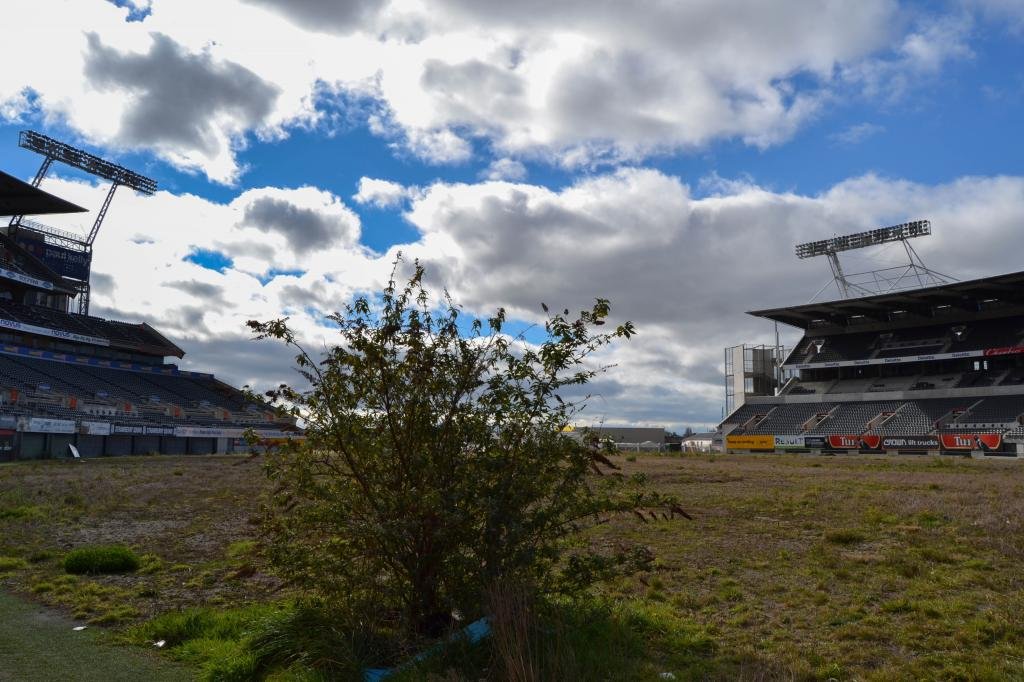
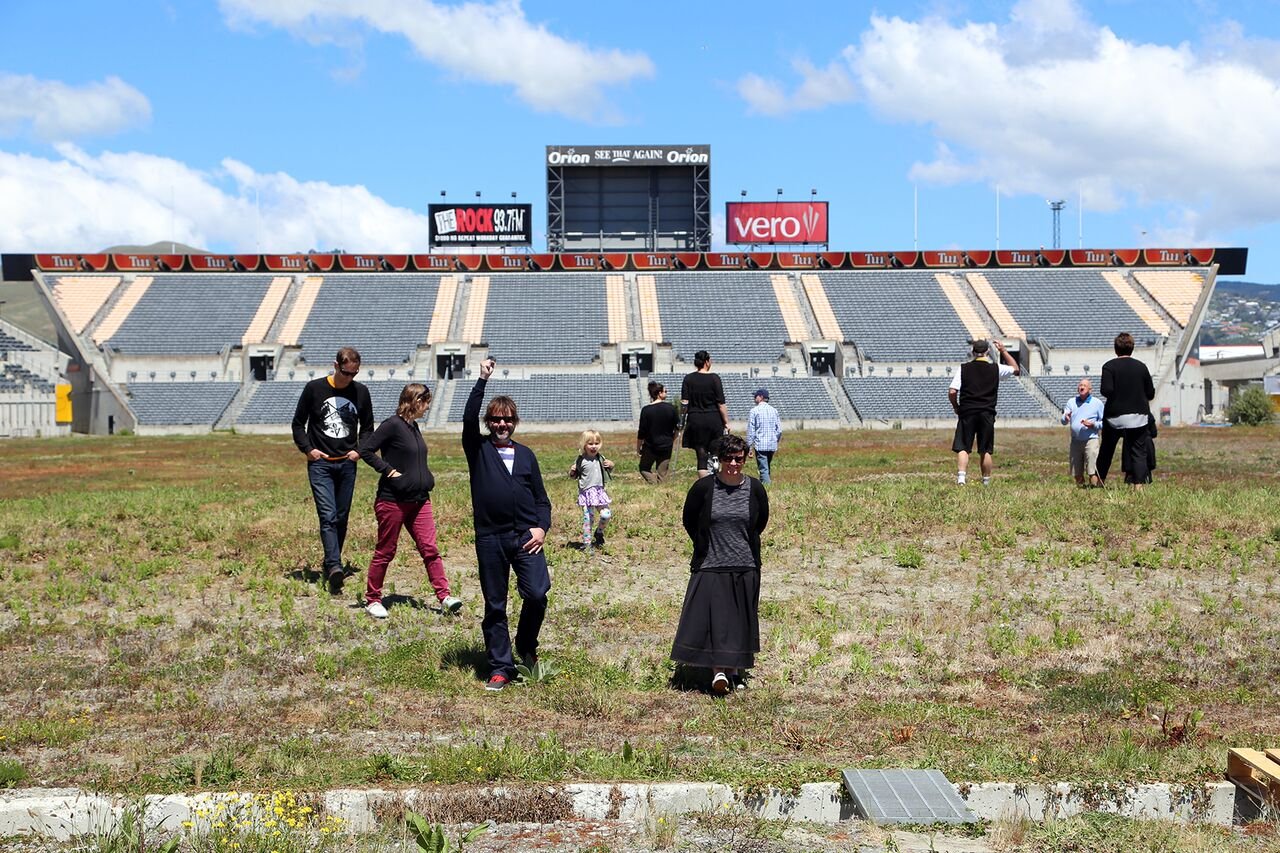
The Stadium Broadcast was a 72-hour live radio work staged inside the disused AMI Stadium in Christchurch, three years after the 2011 earthquakes.
The project didn’t begin with the stadium. It began with research.
Through their involvement in Live Art List Australia (LALA), Field Theory had started writing and documenting encounters with experimental practices across Australia. This gradually extended to Aotearoa New Zealand, where members of the collective began tracking the emergence of small, often informal artist-led projects and collectives operating in Christchurch in the aftermath of the earthquakes.
What they found was a city working in provisional ways. With much of the central infrastructure damaged or gone, artists were operating in temporary spaces, empty lots, and self-organised systems. The work was responsive, often ephemeral, and frequently under-documented. Conversation became the primary method of access.
This mode of working had earlier been tested in Durational Lattes (2011), where Field Theory treated meetings, conversations and encounters as live material. That project suggested a shift: that discursive, “live” research could itself be structured as performance. The broadcast model extends this logic. Instead of mapping conversations after the fact, it holds them in real time—continuous, unstable, and shared.
The broadcast model emerged from this trajectory. Rather than documenting work after the fact, Field Theory began experimenting with real-time transmission as a way to hold and circulate conversations as they happened. Broadcasting allowed multiple voices to coexist without needing to resolve them into a single narrative.
After almost two years of research and planning, Field Theory secured access to AMI Stadium through Christchurch City Council and the stadium’s owners. The project took place over Canterbury Anniversary weekend in November 2014. At that point, no members of the public had entered the field since it was closed following earthquake damage in 2011.
For those three days, it was the only time the public was allowed back onto the field.
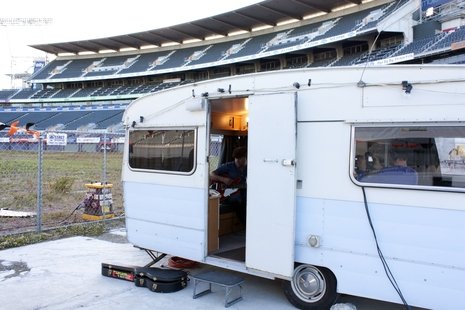
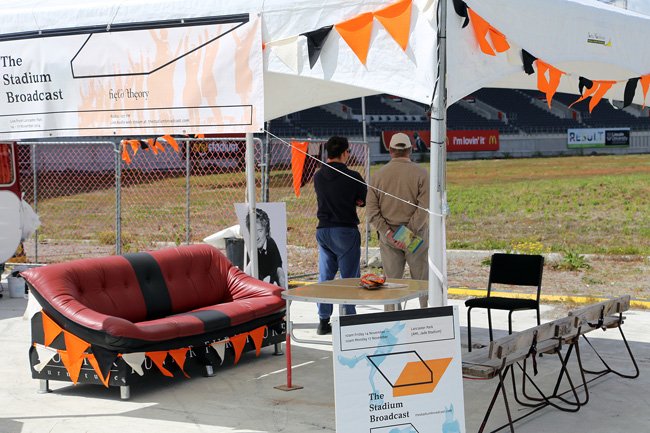
Field Theory established a temporary camp on the concrete pad of the demolished Hadlee Stand. There were three caravans, a small public marquee, and a transmission system built with local technician Simon Kong. A transmitter was mounted to the highest remaining structure, and one caravan was converted into a radio studio overlooking the field. It was functional, compact, and increasingly difficult to inhabit over time.
The premise was simple.
For three days and nights, the people of Christchurch were invited to stand on the field—possibly for the last time—and tell their stories of the stadium. The broadcast ran continuously, day and night, without leaving the ground.
Stories ranged widely. A match, a concert, a moment in the stands. The seat you stole. The ball you caught. The fence you jumped. Losing your friends and finding someone else. A fleeting encounter that stayed longer than expected. The invitation extended to players, cleaners, punters, pie sellers—anyone with a connection to the place.
The stadium became a platform for accumulation.
Internally, the project followed Field Theory’s working structure. Jason Maling and Martyn Coutts led the development, conducting extended research trips and building relationships across the city. Lara Thoms, Sarah Rodigari and Jackson Castiglione joined shortly before the broadcast, working quickly to absorb a dense and localised history. Anna Schoo was unable to attend, as she was seven months pregnant.
The collective operated in rotating shifts to maintain a continuous transmission. Two people on air, two producing, two attempting to sleep. This structure held, then gradually softened.
The project relied on a broad network of Christchurch collaborators. Libby Sheehy hosted members of the collective during research visits. Mel Oliver, director of The Physics Room, became a key partner, providing space, support and ongoing encouragement. Designer Ella Sutherland developed the project’s visual identity.
At the time of the broadcast, the stadium existed in a state of suspension—closed, unused, and awaiting a decision on its future. It stood as a large, damaged structure: part monument, part ruin, part unresolved question. The field remained intact, but the stands were unstable. Access was tightly controlled. A single security guard monitored the site at night.
The broadcast did not attempt to resolve the future of the stadium. It operated within its uncertainty.
It offered a temporary return.
The entire 72 hours of transmission was recorded and is now held by Ngā Taonga Sound & Vision, the New Zealand audiovisual archive.
The stadium has since been demolished.
All that remains is a plaque.